

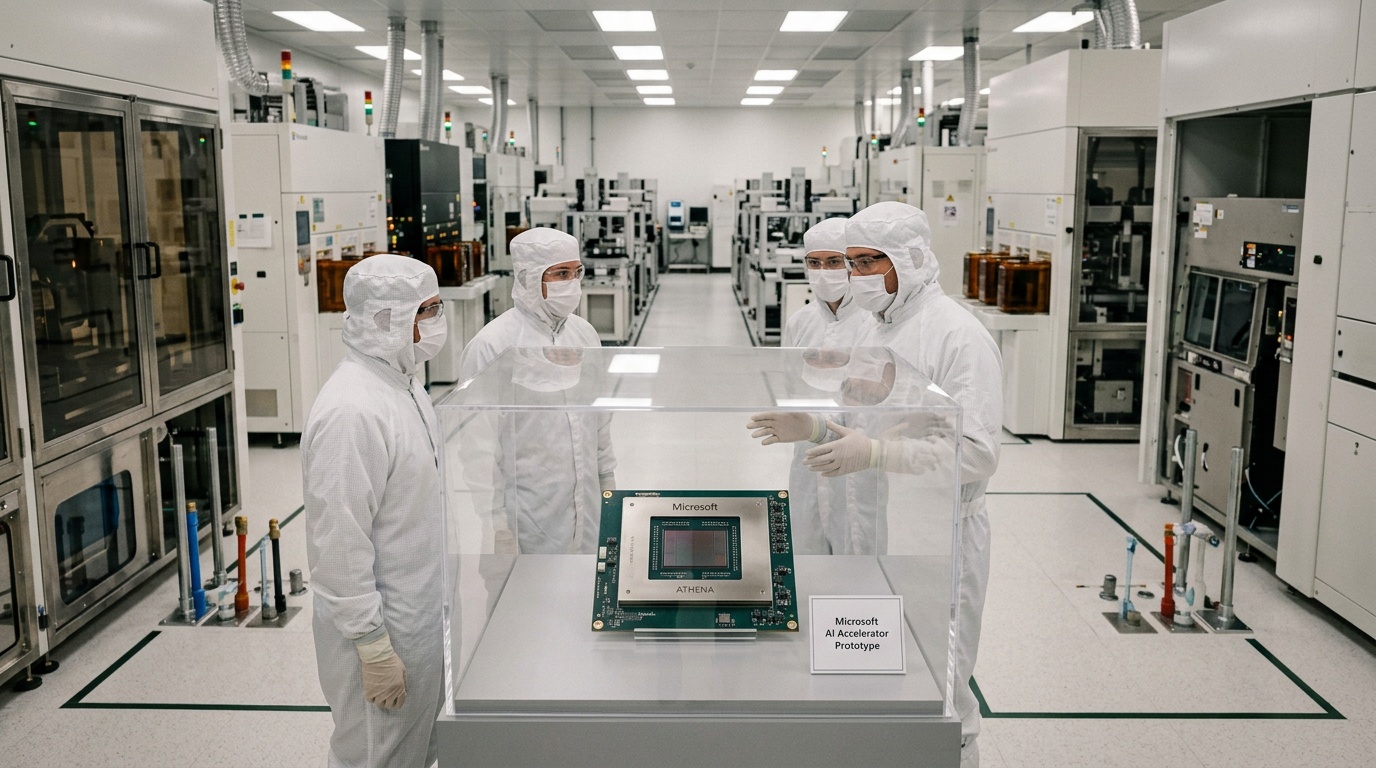
Microsoft has unveiled Maia 200, a second-generation accelerator designed for demanding artificial intelligence workloads. The chip expands Microsoft’s control over the infrastructure supporting Azure and its growing collection of AI services. Microsoft says Maia 200 focuses heavily on inference, which happens when trained models process requests and generate responses. Its arrival also highlights the enormous resources required to build and deploy advanced processors.
The announcement comes as semiconductor companies warn about possible shortages across the chipmaking equipment industry. Manufacturers need specialized machines to produce leading processors, memory chips, and advanced packaging systems. Demand from cloud providers, national subsidy programs, and consumer electronics companies continues straining that supply chain. Microsoft’s new accelerator therefore enters a market shaped by technical ambition and manufacturing constraints.
Microsoft Expands Its Custom Silicon Strategy
Microsoft began publicly outlining its custom AI silicon strategy with the Maia 100 accelerator in 2023. The company developed that processor for Azure-based training and inference tasks. Maia 200 extends the strategy with newer manufacturing technology, faster memory, and stronger support for lower-precision calculations. Those calculations help AI systems process information while reducing energy use and operating costs.
Microsoft says Taiwan Semiconductor Manufacturing Company produces Maia 200 using an advanced three-nanometer process. Smaller manufacturing nodes generally allow designers to place more transistors within a limited area. Microsoft reports that Maia 200 contains more than 100 billion transistors. However, transistor counts alone cannot determine performance across varied AI workloads.
The chip supports compact numerical formats commonly used for modern inference. Microsoft says it can deliver roughly 10 petaflops using four-bit operations. It can also provide about five petaflops with eight-bit calculations, according to the company. These formats can accelerate large models without requiring full numerical precision for every operation.
Memory Capacity Supports Larger Models
Maia 200 includes 216 gigabytes of high-bandwidth HBM3E memory, Microsoft says. The memory system offers approximately seven terabytes of bandwidth each second. High bandwidth allows the processor to retrieve model parameters and intermediate results quickly. That capability matters because memory movement frequently limits AI performance more than raw computing power.
Microsoft also designed networking, cooling, software, and server systems around the accelerator. Cloud operators rarely deploy powerful AI chips as isolated components. They connect thousands of accelerators to create clusters capable of serving models at enormous scale. Consequently, system design often determines whether impressive laboratory specifications produce practical customer benefits.
Software represents another essential part of Microsoft’s approach. Developers need compilers, libraries, management tools, and monitoring systems before they can use custom processors efficiently. Microsoft has created a Maia software development kit for that purpose. The company can also optimize internal services before offering broader access through Azure.
Custom Chips Can Reduce Dependence
Microsoft remains a major customer of Nvidia, whose graphics processors dominate commercial AI computing. The company also offers hardware from other suppliers through Azure. Maia does not immediately replace those products across every workload. Instead, custom silicon gives Microsoft another option for controlling performance, availability, energy consumption, and long-term costs.
This approach resembles strategies pursued by Amazon and Google. Amazon develops Trainium accelerators, while Google operates several generations of tensor processing units. Meta has also created processors for selected recommendation and inference workloads. Each company wants hardware tailored closely to its software, data centers, and economic requirements.
However, designing a chip does not create independent manufacturing capacity. Microsoft still relies on outside foundries, memory producers, packaging providers, and equipment manufacturers. That dependence connects Maia 200 directly to wider semiconductor supply conditions. The next challenge begins long before finished processors reach Microsoft’s data centers.
Equipment Constraints Threaten Expansion
Leading semiconductor factories use thousands of complex tools across hundreds of production stages. These systems deposit materials, create microscopic patterns, remove unwanted layers, and inspect tiny defects. Only a limited group of companies can manufacture many critical machines. Expanding production therefore requires years of planning, construction, installation, and qualification.
ASML remains the sole commercial supplier of extreme ultraviolet lithography systems. Chipmakers use those machines to print the smallest features on advanced processors. Each system contains intricate optics, lasers, vacuum equipment, and components from numerous specialized suppliers. Any production disruption can delay an entire fabrication facility’s expansion schedule.
Other manufacturing stages depend on equipment from Applied Materials, Lam Research, Tokyo Electron, KLA, and additional suppliers. These companies must expand carefully because semiconductor demand follows unpredictable cycles. Building excessive capacity can create heavy losses during a downturn. Building too slowly can produce bottlenecks when several chipmakers expand simultaneously.
Advanced Packaging Creates Another Bottleneck
AI accelerators require more than advanced processor wafers. They also need high-bandwidth memory and sophisticated packaging that connects memory closely with computing components. Packaging facilities require specialized bonding, inspection, and testing equipment. Strong AI demand has forced suppliers to accelerate investments across this less visible manufacturing segment.
HBM production also consumes greater manufacturing capacity than conventional memory. Suppliers must stack several memory layers and connect them through microscopic vertical pathways. SK Hynix, Samsung, and Micron have increased HBM investments to address rising demand. Nevertheless, qualification requirements prevent cloud companies from switching suppliers instantly during shortages.
These constraints do not mean every machine or component faces an immediate shortage. Semiconductor markets contain many product categories with different supply conditions. Older manufacturing equipment may remain available while leading systems develop lengthy delivery schedules. The greatest pressure usually appears where technical complexity meets rapidly growing demand.
Geopolitics Complicates the Supply Picture
Governments increasingly treat semiconductor manufacturing as a national security priority. The United States, European Union, Japan, South Korea, and China have supported major domestic investments. These programs can strengthen regional supply chains over time. They can also intensify short-term equipment demand as numerous subsidized factories begin construction together.
Export controls add further uncertainty for equipment manufacturers and chip designers. American, Dutch, and Japanese rules restrict certain advanced technologies from reaching selected Chinese customers. Suppliers must navigate changing license requirements while planning factories and research programs. Those restrictions can redirect orders without reducing worldwide demand for computing capacity.
Microsoft must also consider electricity, water, land, and network availability. An accelerator cannot create value without a data center capable of operating it reliably. Advanced AI facilities can require enormous power connections and extensive cooling infrastructure. Delays in energy projects may therefore limit deployments even when chips remain available.
Maia 200 Reflects a Broader Industry Shift
Maia 200 demonstrates how cloud companies increasingly shape semiconductor design. Microsoft can study its own workloads, identify recurring bottlenecks, and create hardware around those findings. It can also coordinate processor development with software teams and data center engineers. Traditional chip suppliers must now compete with customers that possess substantial engineering budgets.
Customers may eventually benefit from greater hardware diversity within Azure. Specialized accelerators could lower inference prices or improve service availability for particular models. However, Microsoft must prove reliability, software compatibility, and consistent performance at large scale. Developers often prefer mature platforms because moving workloads requires time and technical work.
The unveiling does not solve the semiconductor industry’s physical supply challenges. Instead, it increases pressure on foundries, memory producers, packaging companies, and equipment suppliers. Microsoft’s progress will depend on successful coordination across that network. The same reality applies to every company racing to build larger AI systems.
Equipment makers can expand capacity, but they cannot quickly reproduce specialized expertise or precision manufacturing. Cloud providers must therefore secure supply agreements while improving the efficiency of existing hardware. Better models and software can reduce unnecessary computation alongside new chip investments. As equipment constraints loom, efficient deployment may become as important as processor performance.
